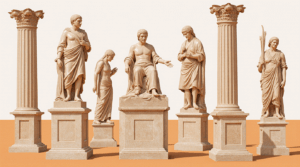
The first philosophers, those early thinkers who pondered the nature of reality itself, often began their inquiries with questions so simple yet profound: what is real? What can we know about the world around us? How do we make sense of existence in an unknown and sometimes chaotic universe? These queries form the bedrock upon which philosophy was built, serving as a launching point for countless subsequent debates and explorations. The first philosophers were driven by a fundamental desire to understand not just the world but their own place within it—a quest that, despite millennia of progress, continues to captivate us.
One of the earliest philosophical questions concerned the distinction between the world we perceive through our senses and what might lie beyond them. This duality has fascinated thinkers for centuries, particularly the ancient Greeks who grappled with it in their pursuit of knowledge. For Thales of Miletus, often regarded as one of the first philosophers, water was the fundamental element from which all else arose. His student Anaximenes proposed that air was the source of everything, while Anaximander suggested an eternal, unbounded substance he called apeiron, meaning “the limitless.” These theories, though rudimentary by today’s standards, were groundbreaking because they represented a shift away from mythological explanations towards naturalistic ones. They also hinted at the complex relationship between what we see and what might be real.
The concept of reality itself became a central preoccupation for early thinkers. How do we determine what is true? Is there an objective reality independent of human perception, or are our perceptions all that matter? Plato’s famous Allegory of the Cave illustrates this dilemma vividly: prisoners in a cave can only see shadows cast on the walls by objects behind them. These shadows become their entire reality until one prisoner escapes and sees the world outside for the first time. This story encapsulates the tension between what we know based on our senses (the shadows) and what might be true beyond those limits (the sun and the world of forms).
The question of certainty also looms large in early philosophical inquiries. How can we be certain about anything? This skepticism, championed by Pyrrho of Elis, took the idea that knowledge is uncertain to its extreme, advocating a path of aporia or perpetual inquiry without conclusion. For Pyrrho and his followers, recognizing the limits of our understanding could lead to a more tranquil state of mind—though this approach has been criticized for potentially leading to paralysis.
Early philosophers also grappled with the nature of change. Parmenides argued that motion and change are illusions, claiming that reality is unchanging and eternal. Zeno of Elea’s paradoxes, such as the dichotomy or Achilles and the tortoise, challenged these ideas by illustrating how seemingly impossible scenarios could arise from the assumption of continuous change. These paradoxes forced early thinkers to consider the nature of time, space, and motion in more nuanced ways.
The relationship between mind and body also emerged as a crucial question for early philosophers. How do our minds interact with or influence our bodies? This issue became particularly pressing during the Hellenistic period, especially among Stoics like Zeno of Citium and his successors. For them, the body was seen not as an obstacle to rational thinking but as an extension of it—a vessel through which reason could operate. Conversely, Epicureans like Lucretius emphasized the physicality of existence, arguing that pleasure and pain are rooted in bodily experiences.
The first philosophers also tackled questions about ethics and morality, laying down foundational ideas that continue to influence contemporary debates. Socrates famously claimed “the unexamined life is not worth living,” suggesting that virtue lies in self-reflection and knowledge. His method of questioning others—known as the Socratic elenchus—remains a powerful tool for critical thinking today.
In conclusion, the first philosophers’ quest to understand reality, knowledge, and existence laid the groundwork for much of Western philosophy. Their inquiries into these fundamental questions continue to resonate because they touch on core aspects of human experience: how we perceive the world, what certainty means, whether change is real, how mind and body relate, and why ethics matter. These early thinkers set in motion a chain reaction of inquiry that has shaped not only philosophical discourse but also scientific understanding and cultural evolution. Their work remains relevant because it challenges us to continually question our assumptions about reality, knowledge, and existence, prompting us to seek deeper truths beyond the surface-level appearances we encounter daily.
By reflecting on these early philosophical explorations, we are reminded of the enduring human drive to make sense of a complex and often mysterious world. The first philosophers may have started with simple questions but their inquiries opened up vast realms of thought that continue to inspire new generations of thinkers. In this way, they not only shaped philosophy but also contributed significantly to our broader understanding of what it means to be human in a complex and interconnected universe.