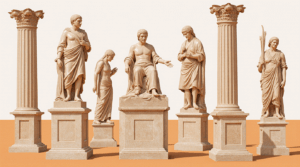
In the quiet contemplation of thought and repetition, a profound distinction emerges. Thought, like a river carving the landscape of the mind, flows with the currents of reflection and discovery. It is a process of questioning, of examining the world and one’s own existence through a lens of curiosity and skepticism. Thought invites us to explore the depths of our understanding, to question assumptions, and to seek out new perspectives that challenge the status quo.
Repetition, resembles the steady, unyielding march of a glacier. It is the persistence of actions, words, or ideas without much reflection or alteration. Repeating what one has heard, seen, or experienced before may feel like a form of stability and certainty, but it often does not engage with the underlying principles or meanings behind those actions or ideas. Repetition can be comforting, as it offers a sense of familiarity and control, but it also has the potential to become stagnant and hollow.
To delve deeper into this distinction, consider a simple example: a person repeating a statement they heard in a conversation versus another person who reflects on that statement and questions its validity. The first individual might repeat the statement verbatim, perhaps even with conviction, simply because it aligns with their existing beliefs or because it is convenient to do so. The second individual, through thought, would not only repeat the statement but also critically analyze its meaning, context, and implications. This analysis might lead to a deeper understanding of the statement’s truth or falsehood, or it might result in the formulation of a counterargument that challenges the original statement.
Thought, involves an active engagement with the world and our experiences. It is not merely the mechanical recitation of facts or ideas but rather a dynamic process of exploration and creation. Thought requires mental effort and intellectual agility, as it demands the integration of knowledge from various sources and the application of critical thinking skills to draw meaningful conclusions. In this way, thought is a form of personal growth and development, constantly refining our understanding of the world and ourselves.
Repetition, is often seen as a simpler and more effortless activity. It does not necessitate deep cognitive processing or emotional engagement. A person can repeat something without fully comprehending its significance or even remembering why they are doing so. This lack of deeper involvement can make repetition appear less demanding but also less transformative. While repetition can be valuable in certain contexts, such as learning a skill through practice, it becomes problematic when it replaces genuine reflection and introspection.
To illustrate the difference further, consider the concept of knowledge. Knowledge gained through thought is often more nuanced and comprehensive. It involves not just accepting information at face value but questioning its sources, validity, and applicability in various contexts. Thoughtful individuals are more likely to seek out multiple perspectives and integrate diverse viewpoints to form a well-rounded understanding of complex issues. Repeated knowledge may be more superficial, lacking the depth of analysis that comes from critical thinking.
Thought encourages innovation and creativity. When we engage deeply with ideas, we are more likely to develop new insights and original solutions to problems. The act of reflection often leads to the formulation of novel ideas or the reimagining of existing ones in fresh ways. This is why thinkers throughout history—from scientists to artists to philosophers—have emphasized the importance of questioning and exploring beyond the surface level of things.
Repetition tends to reinforce existing patterns without challenging them. It can be a powerful tool for maintaining consistency and stability but can also prevent progress and growth. When we rely solely on repetition, we may miss out on opportunities for discovery and innovation. The world is constantly changing, and our understanding of it must evolve accordingly. Thought, by its nature, is adaptive and open to change, whereas repetition can become a rigid and unyielding force.
The distinction between thought and repetition also has implications for personal development. Thought encourages self-awareness and personal growth. When we engage in deep reflection, we are more likely to recognize our own biases, assumptions, and areas of ignorance. This awareness can lead to transformative changes in our beliefs and behaviors. Repetition often operates on a subconscious level, reinforcing existing habits and attitudes without prompting significant introspection or change.
The quality of thought is not merely about the content of our ideas but also about the process through which we arrive at them. Thoughtful reflection involves questioning, analyzing, and integrating diverse perspectives. It requires active engagement with the material, rather than passive absorption. This process of deep thinking can lead to a richer and more meaningful experience of life.
In today’s fast-paced world, where information is abundant but often fragmented, the ability to engage in thoughtful reflection becomes increasingly valuable. In an era of instant gratification and constant distraction, thought encourages us to slow down, to examine our experiences more deeply, and to seek out meaningful connections between ideas and actions. Thought, unlike repetition, has the potential to transform not just our understanding of the world but also our place within it.
While both thought and repetition serve important functions in our lives, the difference between them lies in their capacity to engage with the world and ourselves. Thought invites us into a realm of exploration, discovery, and growth, whereas repetition can often be a passive and unreflective process. As we navigate the complexities of modern life, cultivating the habit of thoughtful reflection can enrich our experiences and deepen our understanding of the world around us.