
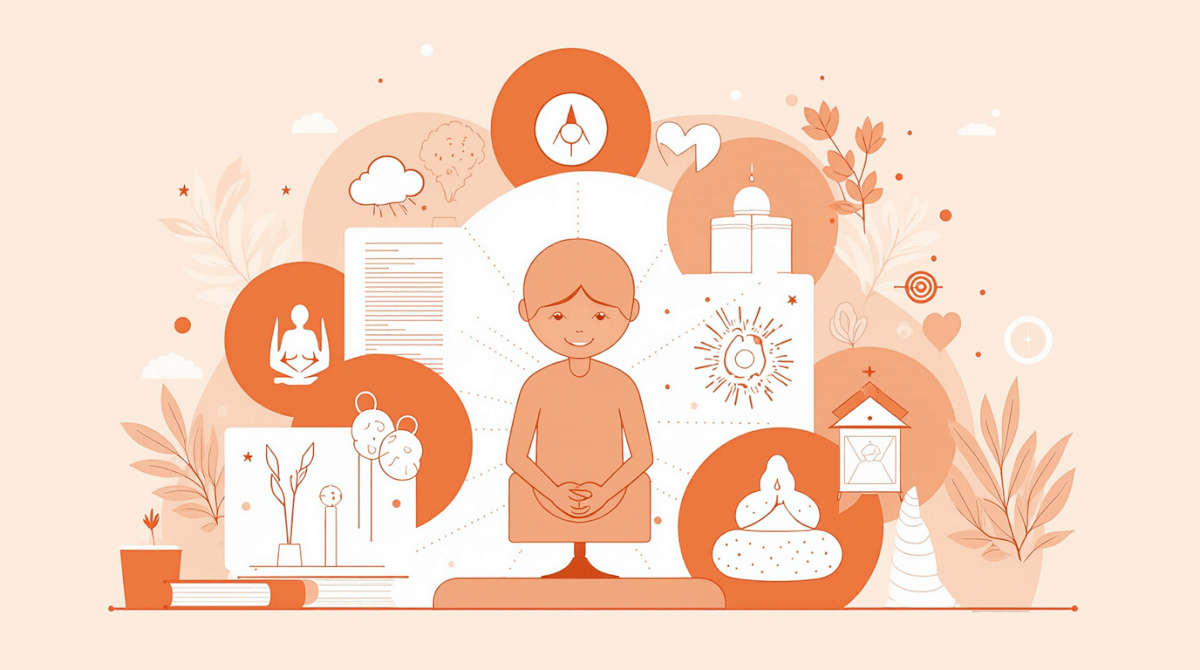
There are moments when noise fades.
Not because the world becomes quiet — but because something inside demands attention.
A question.
A longing.
A sense that life must mean more than routine.
Spirituality often begins there.
Not in doctrine.
Not in ritual.
But in awareness.
It arises when a person senses depth beneath the surface of daily existence.
It is less about institution and more about interior orientation.
Less about structure, more about experience.
And yet, it can shape a life as powerfully as any organized belief system.
Spirituality Beyond Religion
Spirituality is often confused with religion, but the two are not identical.
Religion is structured.
Spirituality is experiential.
Religion organizes belief through tradition, authority, and communal practice.
Spirituality focuses on personal connection — to meaning, to consciousness, to transcendence, to something greater than the self.
Some people experience spirituality within religious traditions.
Others pursue it independently.
What unites spiritual inquiry is the desire to understand existence at a deeper level.
The Search for Meaning
One of spirituality’s core elements is the search for meaning.
Beyond career.
Beyond success.
Beyond material achievement.
Spiritual reflection asks:
What is the purpose of my existence?
What gives life depth?
What remains when distractions are removed?
Meaning is not always found in dramatic revelation.
Often it develops gradually — through reflection, suffering, gratitude, or quiet realization.
Spirituality encourages that reflection.
Inner Awareness and Consciousness
Spiritual growth often involves increased awareness.
Awareness of thought patterns.
Awareness of emotional states.
Awareness of interconnectedness.
Practices such as meditation, contemplation, or mindful presence aim to cultivate clarity.
They slow reaction.
They reduce mental noise.
They strengthen internal stability.
Spirituality, in this sense, becomes a discipline of attention.
Transcendence and the Sense of Something Greater
Many spiritual traditions, religious or not, point toward transcendence.
This may be understood as:
-
A divine presence.
-
Universal consciousness.
-
The interconnectedness of life.
-
A higher moral order.
-
A reality beyond the material.
The language varies.
The experience often feels similar — a recognition that existence extends beyond immediate perception.
This recognition can produce humility.
It can also produce peace.
Suffering and Growth
Spiritual development frequently deepens through difficulty.
Moments of loss, uncertainty, or crisis often push individuals toward deeper questioning.
Why is there suffering?
What can be learned from pain?
How should hardship shape character?
Spiritual frameworks do not always remove suffering, but they provide context for interpreting it.
In many traditions, growth emerges through endurance and reflection.
Compassion and Connection
Spiritual awareness often expands concern beyond the self.
As perspective deepens, empathy widens.
Compassion becomes less optional and more natural.
A spiritually grounded individual may recognize:
Shared vulnerability.
Shared fragility.
Shared humanity.
This recognition strengthens ethical behavior without requiring external enforcement.
Connection becomes internalized.
Presence and Simplicity
Spiritual life does not always demand complexity.
Often it invites simplicity.
Attention to breath.
Attention to gratitude.
Attention to daily actions.
Presence transforms routine moments into meaningful experiences.
A meal becomes gratitude.
A conversation becomes attentiveness.
A quiet walk becomes reflection.
Spirituality anchors awareness in the present rather than constant distraction.
Individual Pathways
No two spiritual journeys look identical.
Some people find depth through structured practice.
Others through nature.
Others through art.
Others through service.
The form varies, but the core remains:
A movement inward.
A movement upward.
A movement toward coherence.
Spirituality allows flexibility without abandoning seriousness.
The Risk of Abstraction
Spirituality can become vague if not grounded.
Without reflection and discipline, it risks becoming sentiment without substance.
True spiritual development requires:
-
Self-examination.
-
Consistent practice.
-
Ethical alignment.
-
Openness to growth.
Depth does not emerge from occasional inspiration. It grows through intentional engagement.
Living Spiritually
To live spiritually is not to withdraw from reality.
It is to approach reality with awareness.
It involves:
-
Acting with intention.
-
Responding rather than reacting.
-
Valuing depth over distraction.
-
Seeking meaning beyond consumption.
Spirituality does not eliminate difficulty.
It reframes it.
It does not remove uncertainty.
It provides orientation within it.
Spirituality represents the human impulse to look beyond surfaces.
To ask deeper questions.
To seek coherence.
To connect inner life with outer action.
It is less about declaring belief and more about cultivating awareness.
And when practiced with sincerity, spirituality becomes not an escape from life — but a way of living it more fully.



Be First to Comment