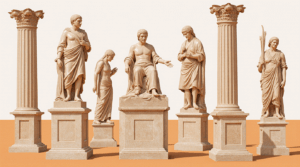
Socrates, Plato, and Aristotle: Foundations of Western Thought
The pillars of Western philosophy—Socrates, Plato, and Aristotle—represent more than just ancient thinkers; they embody the genesis of critical inquiry and rational thought that continue to shape our intellectual landscape. Understanding their contributions is essential for grasping how modern Western culture developed its concepts of knowledge, ethics, politics, and reality. These philosophers did not merely theorize in isolation; they dialogued with and built upon one another’s ideas, creating a rich tapestry that informs contemporary debates from democratic governance to science and ethics. Exploring their philosophies reveals not only the roots of Western thought but also their enduring relevance in today’s world, where questions of truth, justice, and the good life remain profoundly pertinent.
Socrates: The Questioning Mind and Ethical Inquiry
Socrates, often considered the founding figure of Western philosophy, transformed the approach to knowledge through his relentless questioning method known as the Socratic method. Rather than providing answers, Socrates challenged assumptions, exposing contradictions in others’ beliefs to stimulate critical thinking and self-examination. His famous claim that “the unexamined life is not worth living” underscores his commitment to ethical self-reflection and intellectual humility. This focus on ethics and virtue was revolutionary at a time when philosophy was largely concerned with natural phenomena or abstract metaphysics.
Historically, Socrates’ trial and execution in 399 BCE for allegedly corrupting the youth of Athens and impiety illustrate the political ramifications of his method and ideas. His dedication to truth over social conformity positioned him as a martyr for intellectual freedom. Philosophically, he laid the groundwork for later developments in epistemology and morality by insisting that knowledge must be actively sought and that ethical behavior stems from understanding what is truly good.
In a modern context, the Socratic method is widely used in education to foster critical thinking and dialogue, particularly in law schools and philosophical debate. For instance, in contemporary classrooms, instructors employ Socratic questioning to encourage students not just to memorize but to evaluate arguments, a direct echo of Socrates’ legacy. His insistence that questioning is foundational to wisdom remains a potent reminder of the importance of inquiry in an age prone to information overload and superficial acceptance of facts.
Plato: The Realm of Forms and the Pursuit of Ideal Justice
Plato, a devoted student of Socrates, took his mentor’s ideas further by systematizing philosophy through dialogues and developing a metaphysical theory known as the Theory of Forms. For Plato, the empirical world is just a shadow or imperfect reflection of a higher, eternal reality composed of perfect “Forms” or “Ideas.” This dualistic vision posits that true knowledge is not sensory but intellectual, accessed by reason contemplating these timeless Forms. For instance, the Form of “Justice” represents the perfect and unchanging essence of justice beyond any flawed legal system.
Plato’s philosophical inquiries extend to politics and ethics, most famously presented in his work The Republic, where he outlines a vision for an ideal state ruled by philosopher-kings—individuals who understand the Forms and thus can govern justly. This idea links epistemology directly with political philosophy, suggesting that knowledge and virtue are prerequisites for good leadership.
Historically, Plato’s influence is profound, shaping the development of Western political theory and philosophy for centuries. His dialogues served as the primary texts in medieval scholasticism and continue to provoke debate about the relationship between reality, knowledge, and morality.
In the modern day, Plato’s emphasis on ideals and the design of just institutions echoes in contemporary discussions about governance, human rights, and social justice. For example, debates about constitutionalism and the rule of law reflect a desire to approximate the kind of justice Plato envisioned—a system rooted in rational principles rather than arbitrary power. Additionally, the educational ideal of cultivating wise and virtuous leaders remains an enduring legacy from Plato’s political philosophy.
Aristotle: Empiricism, Logic, and the Foundation of Science
Aristotle, Plato’s student, marked a distinct turn toward empirical observation and systematic analysis. Rejecting his teacher’s metaphysical Theory of Forms, Aristotle emphasized studying the natural world directly to understand its causes and principles. His approach laid the foundation for modern science by developing formal logic as a tool for reasoning systematically. The Organon, Aristotle’s collection on logic, introduced the syllogism, a form of deductive reasoning that remains fundamental in philosophy, mathematics, and computer science.
Aristotle’s ethical philosophy, centered on the concept of virtue as a mean between extremes and the idea of eudaimonia (often translated as flourishing or well-being), provided a practical framework for living well—grounded not in abstract ideals but in real human experience and community life. Unlike Plato’s ideal forms, Aristotle’s ethics focus on cultivating habits that support a balanced and fulfilling life.
Historically, Aristotle’s influence permeated many fields—biology, metaphysics, ethics, and politics—serving as the backbone of medieval scholastic thought and eventually inspiring the scientific revolution. His insistence on observation and classification paved the way for developments in empirical science, making him one of the original architects of the Western intellectual tradition.
In contemporary terms, Aristotle’s emphasis on observation and logic resonates in the scientific method used to explore and understand reality. His ethical framework informs modern virtue ethics, a growing field in philosophy that offers an alternative to rule-based ethical systems. Moreover, his holistic view of human flourishing continues to influence psychology, political theory, and even leadership studies, reflecting the ongoing relevance of his work.
Conclusion: Enduring Lessons from the Foundations of Western Thought
Socrates, Plato, and Aristotle collectively established the foundation of Western thought by charting the course from questioning and ethical inquiry, through metaphysical idealism, to empirical observation and systematic logic. Their diverse yet interconnected philosophies not only shaped the development of Western intellectual history but also offer profound insights for individual and societal challenges today. Engaging with their ideas encourages us to examine our assumptions critically, seek justice grounded in reason, and cultivate virtues that promote human flourishing. In a world inundated with information and ethical complexity, the lessons derived from these ancient philosophers remind us that the pursuit of truth, wisdom, and a meaningful life remains an essential human endeavor—one that transcends time and culture, enriching both our personal experiences and collective existence.