
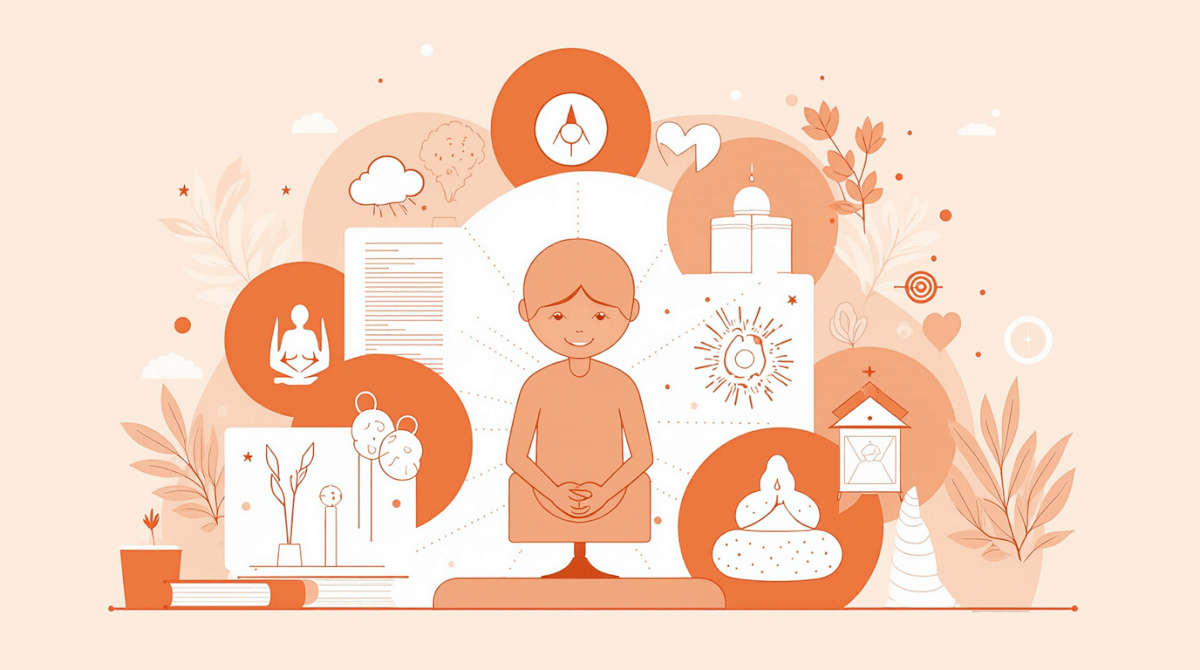
In the quiet of a morning, before any distractions of the day intrude, I find myself seeking out that moment when my mind can settle into its natural state—a place of inner silence. This is more than just an absence of noise; it’s a profound exploration of self and spirit. It is in these moments of stillness that one begins to sense the presence of something greater within oneself.
The search for meaning, transcendence, or simply depth, often starts as a quiet conversation with oneself. In the inner silence, we are not just aware of the absence of external sounds; we are also conscious of the layers beneath our surface thoughts and emotions. This awareness can be disorienting—like stepping into an unknown space where certainty feels tenuous, yet there is a sense of potential for deeper understanding.
This journey into the self often begins with a question of identity. What am I? Where do I come from? Why am I here? These existential queries can lead to moments of profound uncertainty, a state that can be uncomfortable but also profoundly liberating. In these uncertain spaces, we realize that our identities are not fixed entities but fluid constructs shaped by experiences and beliefs. The process of questioning our core beliefs allows for a more nuanced understanding of ourselves and the world around us.
Belief systems, whether religious or philosophical, play a significant role in shaping identity. They provide frameworks through which one can make sense of life’s complexities. A person who identifies with a particular faith may find comfort in rituals that offer a sense of connection to something larger than themselves. These practices—praying, meditating, reading scriptures—become part of their daily routine and contribute to a sense of belonging within a community.
The inner silence also invites us to question these frameworks. It challenges our certainties and forces us to confront doubts and uncertainties head-on. This is where the tension between control and surrender becomes apparent. We seek assurance and stability in belief systems; on the other, we are compelled by the inner voice of curiosity and openness. The path forward is often a balance between holding onto what provides comfort and embracing the unknown.
In the realm of spirituality, this exploration of self is both psychological and existential. It touches upon the core of our being—our sense of purpose, connection to others, and place in the universe. These questions are not just intellectual exercises; they have emotional depth and can evoke a range of feelings from fear and anxiety to peace and joy.
The complexity of human experience means that there is no single answer or pathway for this journey. Each person navigates these inner landscapes uniquely, influenced by their cultural background, personal history, and current circumstances. It’s important to recognize the diversity in how people engage with spirituality, whether through organized religion, personal belief systems, or a more secular approach.
In moments of solitude, perhaps during a walk in nature or a quiet evening at home, one can experience a sense of presence that is both comforting and profound. This presence is not something external but an inner state where the mind and body are aligned, allowing for a deeper connection to oneself and the world around us. It’s here, amidst this stillness, that one can begin to uncover the layers of their own soul.
Listening to the inner silence is about embracing the complexity of human experience—embracing both the moments of certainty and those times when doubt seems overwhelming. It is a practice of presence, of being fully present in each moment, however fleeting or intense. Through this practice, we may find not just answers but a deeper sense of connection to our inner selves and the world beyond.
Spirituality as an inner experience is a journey of self-discovery that invites us to explore the depths of our souls. It is both challenging and rewarding, offering a path towards greater understanding, compassion, and a more meaningful life.
To explore the broader framework behind this topic, read
Living Your Beliefs: When Faith and Spiritual Awareness Meet Daily Life.
Related Reading
– Khalil Gibran — The Prophet
– Rumi — Selected Poems



Be First to Comment