
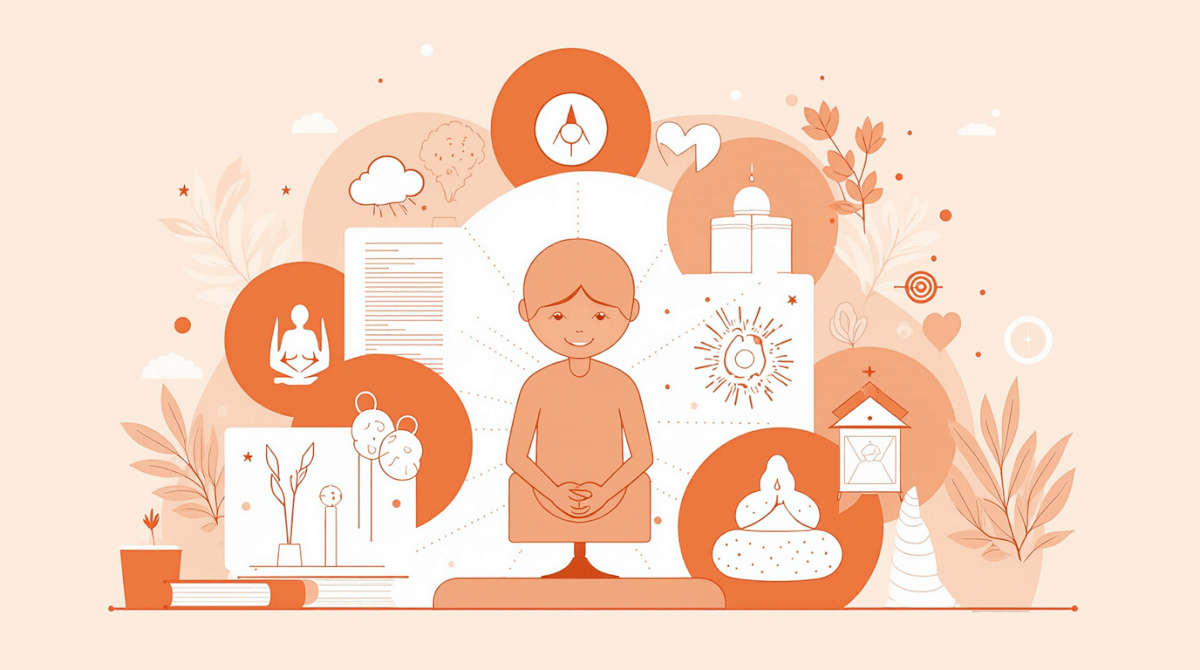
In the quiet of contemplative practice, one finds a space where the cacophony of life’s complexities can be temporarily silenced. This practice, rooted deeply within the individual and unencumbered by institutional frameworks or dogmatic assertions, serves as a sanctuary for exploration into the essence of personal strength. Contemplation is not merely an escape from reality; it is a means to uncover the very core of one’s being—a process that involves navigating through layers of uncertainty and doubt.
At its heart, spirituality in contemplative practice is about delving into the depths of one’s own psyche. It is an intimate journey, often initiated out of a desire for meaning or purpose beyond the immediate concerns of daily life. This search can be triggered by moments of profound uncertainty, such as when facing significant life changes or grappling with existential questions. In these quiet spaces, there exists a tension between certainty and ambiguity, where one acknowledges both the clarity that can emerge from deep reflection and the vast unknowns that persist.
The practice itself is marked by solitude, which often accompanies contemplation. This solitary nature allows for introspection and self-reflection, fostering an environment conducive to understanding oneself on a deeper level. It challenges the tendency to seek external validation or distraction through constant engagement with the world, instead urging individuals to turn inward and observe their own thoughts, emotions, and reactions.
A significant aspect of contemplative practice is its capacity to evoke feelings of transcendence. This does not necessarily imply a departure from reality but rather an expansion of one’s perspective, allowing for a broader understanding of existence. Through sustained periods of quiet reflection, practitioners can experience moments where the boundaries between self and others, between the known and the unknown, become blurred or dissolved altogether. These experiences can lead to profound shifts in perception, enhancing one’s ability to see beyond superficialities and connect with the essence of what truly matters.
Yet, even as contemplation offers these profound insights, it also grapples with persistent uncertainties. Doubt is an ever-present companion on this path, challenging the notion that clarity or certainty can be fully achieved. This tension between doubt and trust serves as a continual reminder of the complexity inherent in human experience. It invites individuals to embrace the unknown rather than shun it, fostering a sense of openness and resilience.
In embracing these inner tensions, one begins to develop a stronger sense of inner coherence. The practice of contemplation allows for integration of disparate aspects of oneself—emotional, intellectual, spiritual—into a unified whole. This coherence manifests not just in the clarity of thought or emotional balance but also in how one interacts with others and navigates the world. It imbues daily actions and decisions with deeper meaning, grounded in a more profound understanding of self and purpose.
Contemplative practice nurtures a sense of control over one’s inner life, even amidst external chaos. This is not to say that individuals are completely unaffected by outside events but rather that they learn to respond to them from a place of inner peace and clarity. The ability to maintain inner stability in the face of external challenges is a form of strength that cannot be quantified or easily described.
Spirituality as experienced through contemplative practice is fundamentally about the individual’s quest for deeper meaning and inner strength. It involves navigating the intricate tapestry of uncertainty and certainty, presence and absence, control and surrender, doubt and trust. Through this exploration, one discovers not just a sense of self but also a framework within which to live more purposefully and authentically. The practice may be humble in its outward expression but profoundly enriching on an inner level, offering a pathway towards understanding oneself and the world in ways that are both profound and personally relevant.
To explore the broader framework behind this topic, read
Living Your Beliefs: When Faith and Spiritual Awareness Meet Daily Life.


Be First to Comment