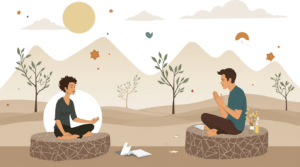
Beliefs are the invisible threads that weave through our everyday lives, often so seamlessly integrated into the fabric of our existence that we barely notice them until they tug us towards a decision or action. Whether rooted in religion or spirituality, these beliefs influence not only how we perceive ourselves and others but also how we navigate the myriad choices that confront us daily.
At its core, belief shapes identity. A person’s religious or spiritual beliefs often form an integral part of their self-concept—defining who they are, what matters to them, and why certain actions might be right or wrong. In a workplace setting where deadlines loom large, the tension between adhering strictly to one’s faith (such as observing prayer times) and professional responsibilities can highlight this interplay of belief versus action. An employee might find themselves caught in an awkward position—balancing the sacred obligations of their religion with the secular demands of their job.
This balance is not always straightforward; it involves a constant negotiation between conviction and compromise, where one must decide how to honor both aspects of their life. In this scenario, religious beliefs might encourage punctuality and respect for others’ work hours (perhaps by choosing non-peak times for prayer), while professional duties may require flexibility or creativity in managing personal obligations.
Belief systems also shape community dynamics and interactions. Shared values within a faith can foster strong bonds among individuals who meet on common ground. A person’s decision to volunteer at a soup kitchen might stem from their belief that caring for the less fortunate is a moral duty prescribed by their religion. Such acts not only reflect one’s commitment but also reinforce communal ties and shared purpose.
This sense of community can sometimes lead to internal conflict when beliefs diverge within the same group. In such cases, individuals may struggle with how to reconcile personal convictions with collective norms or expectations. A debate over whether to adopt more progressive stances on social issues like gender equality might split members along lines of differing interpretations and applications of religious texts.
These tensions are further complicated by external influences, such as societal pressures or changing cultural contexts that may challenge long-held beliefs. In daily life, this could manifest in subtle ways—like a young person feeling the pull between traditional teachings passed down through generations and modern values introduced by peers or media. This internal dialogue can be both enriching and fraught with doubt.
Doubt itself is an integral part of the human experience when it comes to beliefs. It challenges individuals to question, reflect, and sometimes reconsider their stance on certain issues. A person might find themselves questioning the necessity of dietary restrictions prescribed by their faith in light of modern nutritional science. This process can lead to either a reaffirmation of existing beliefs or an evolution towards new understandings.
Belief systems are not monolithic; within any given religion, there is diversity and complexity. Different interpretations of scriptures or varying cultural practices mean that no two individuals will experience their faith in exactly the same way. While some might see religious texts as literal truth, others may interpret them metaphorically, leading to vastly different approaches to daily life.
In terms of practical implications, these diverse perspectives can sometimes lead to conflict within communities. Disagreements over how strictly to follow certain practices or whether new interpretations are valid can create tension and division. They also provide opportunities for dialogue and mutual understanding—allowing individuals from various backgrounds to share their insights and learn from one another.
Values derived from religious beliefs significantly influence everyday routines, communication styles, and the way people fulfill their responsibilities towards others. A person who values humility might prioritize listening over speaking in conversations, while someone focused on charity may volunteer more frequently or donate a larger portion of their income. These value-driven behaviors reflect not just personal preferences but also broader societal norms shaped by religious teachings.
Beliefs are far from static entities; they evolve and adapt as individuals encounter new challenges and experiences. The human dimension in handling doubt is complex and multifaceted, involving psychological, social, and cultural dimensions that intertwine to shape our daily choices and behaviors. While the path may be fraught with tension between conviction and compromise, the journey of exploring these beliefs enriches our understanding not only of ourselves but also of those around us.
This complexity underscores the ongoing nature of belief—constantly in flux yet ever-present as a guiding force in navigating the intricacies of daily life.