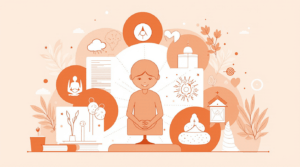
In the quiet of my room on a crisp autumn evening, I find myself reflecting on the essence of spirituality without institutional religion—a practice that has come to define much of my personal journey towards understanding and peace. Spirituality, as an inner human experience, is often intertwined with our search for meaning in life, yet it transcends the confines of organized beliefs and institutions. It emerges from within, a silent conversation between the mind and heart, a dialogue that explores questions of existence, purpose, and the nature of self.
Belief systems have long served as maps to navigate the complexities of human existence. They provide structure, guidance, and a sense of belonging. For many, religion offers a framework for understanding the world, shaping not only their beliefs but also their behaviors and community interactions. It is through these shared narratives that individuals find identity, purpose, and moral clarity. Consider the Sabbath, for instance; it is more than just a day off from work—it is a time for reflection, rest, and reconnecting with one’s faith and community.
As I wander through the corridors of my own inner world, I realize that these frameworks are not always sufficient to address every question that arises. In moments of uncertainty or moral questioning, the rigid structures provided by institutional religions can feel like chains rather than guides. They may offer certainty in a world that often feels full of doubt and ambiguity. The tension between certainty and uncertainty is one of the most profound inner experiences I have encountered.
There is a desire for clarity and direction. This is particularly evident when facing challenging decisions or grappling with existential questions about life’s purpose. Belief systems can provide comfort in times of distress, offering a sense that everything will be okay because it fits into an overarching narrative. This same certainty can be stifling. It can leave little room for personal growth and self-discovery, reducing complex human experiences to simplistic doctrines.
The inner tension between control and surrender is another dimension of my spiritual journey. In moments of crisis or intense stress, there is a natural inclination towards seeking control—wanting to take charge of outcomes, knowing what will happen next. But as I have learned, true peace often comes from relinquishing this desire for certainty and embracing the unknown. Surrender does not mean giving up; it means acknowledging that some aspects of life are beyond our understanding or control. It is in this acceptance that a deeper sense of inner coherence begins to take shape.
Solitude plays a crucial role in this process. It provides space for introspection and contemplation, allowing the mind to wander freely without external distractions. In these quiet moments, I often find myself questioning my own beliefs, exploring the depths of uncertainty and doubt. These are not negative emotions but rather invitations to deeper understanding. They prompt me to examine the very foundations of what I believe and why. It is in embracing both certainty and uncertainty that a more balanced perspective emerges.
The presence of doubt and trust forms an essential part of this inner exploration. Doubt challenges us to question our assumptions, to look beyond surface-level answers and delve into the complexities of human experience. It pushes us to seek out new perspectives and consider multiple viewpoints. Trust, allows us to move forward even when we cannot see a clear path. It is in this dance between doubt and trust that a more resilient sense of self develops.
Religion has often been associated with community and social structures. Belonging to a faith group can offer support and companionship during times of struggle or celebration. The inner journey towards spirituality is an intensely personal one. It requires the willingness to explore one’s own thoughts and feelings without external validation or judgment. This process can be both exhilarating and isolating, as it involves leaving behind familiar frameworks in favor of a more open-ended exploration.
Spirituality without institutional religion does not mean the absence of meaning or purpose. Rather, it is a path towards deeper understanding and inner peace through personal exploration and introspection. It acknowledges the complexity of human existence—embracing both certainty and uncertainty, presence and absence, control and surrender. This journey invites us to question, doubt, and trust, leading ultimately to a more authentic and fulfilling sense of self.
To explore the broader framework behind this topic, read
Living Your Beliefs: When Faith and Spiritual Awareness Meet Daily Life.