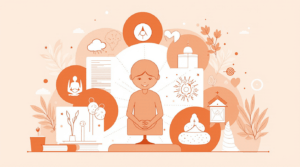
In the quiet solitude of contemplation, an individual stands at the crossroads of their own being—a place where the mind and spirit converge to explore deeper layers of personal growth. This introspective journey is not merely a retreat from the world but a profound engagement with one’s inner self, delving into questions of meaning, purpose, and identity. For many, this process aligns closely with spiritual experiences that transcend mere intellectual or emotional contemplation, touching upon a realm where beliefs shape identity and behavior.
Contemplation often begins as a response to internal uncertainties—a moment of doubt, perhaps, when familiar certainties no longer suffice. This is not an endpoint but a starting point for exploration. During these moments of uncertainty, individuals may find themselves questioning their values, seeking answers that lie beyond the surface of daily life. Such periods can be uncomfortable, even distressing, as one grapples with doubts and insecurities. Yet, it is precisely in these times that contemplation becomes vital; it offers a pathway to navigate through doubt, fostering an environment for introspection and self-discovery.
In exploring spirituality from this inner perspective, the act of contemplation serves as a bridge between the personal and the universal. It allows one to connect with a deeper sense of self, often leading to a recognition of interdependence and interconnectedness. This connection can be profound, offering a feeling of being part of something greater than oneself—a concept that resonates deeply within many spiritual traditions. While these connections may not always have overt religious or organizational affiliations, they do provide a framework for understanding one’s place in the world.
Belief systems play a significant role in shaping this inner landscape. They offer narratives and structures through which individuals can make sense of their experiences, providing a map that guides moral and ethical decisions. For some, these beliefs are deeply personal and intensely individual; for others, they may find solace and strength in community traditions and practices. Both paths reflect the complexity of human spirituality, which is often a mix of individual and collective expressions.
The act of contemplation also reveals inner tensions—between certainty and uncertainty, presence and absence, control and surrender. These tensions are inherent in the human condition and can be sources of both conflict and growth. Moments of doubt can lead to profound realizations about one’s beliefs and values, pushing beyond superficial understandings towards more nuanced perspectives. A sense of presence or grounding can arise from periods of deep contemplation, offering stability amidst life’s chaos.
Surrendering control is another significant aspect of contemplative practices. This does not mean passively accepting all external circumstances but rather embracing the fluidity of life with openness and acceptance. Trust in this process often arises through repeated experiences of letting go, allowing for a more authentic engagement with the present moment. Such moments can be transformative, fostering resilience and a greater capacity to handle uncertainty.
Doubt and trust are interwoven throughout this process, reflecting the complex dance between skepticism and faith. Doubt can be a catalyst for deeper inquiry and self-discovery, while trust allows one to venture into unknown territories with confidence. Balancing these elements requires mindfulness and intentional effort but is essential for sustained spiritual growth.
Contemplation in personal growth is not just about seeking answers or resolutions; it is an ongoing exploration of the self that involves navigating through doubt, uncertainty, and tension towards a more integrated and meaningful existence. This journey, deeply rooted in individual experience, acknowledges the complexity and diversity within human spirituality without resorting to mystical exaggerations or institutional dogma. It invites us to explore our inner landscapes with curiosity and openness, enriching our understanding of ourselves and our place in the world.
To explore the broader framework behind this topic, read
Living Your Beliefs: When Faith and Spiritual Awareness Meet Daily Life.
Related Reading
– Dalai Lama — Ethics for the New Millennium
– Marianne Williamson — A Return to Love