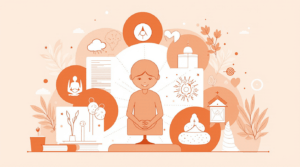
Meditation often feels like a retreat from the clamor of external existence, inviting us to peel back the layers of our busy minds until we find the stillness within. It is this quest for inner clarity that has drawn countless individuals towards various spiritual practices over centuries. For many, meditation becomes a sanctuary where the complexities and uncertainties of life can be examined more closely without the immediate pressures of daily responsibilities.
In the quietude of a meditation session, one might begin to notice the continuous stream of thoughts, emotions, and sensations that fill our consciousness. This constant flow can be both overwhelming and enlightening. It is in this flux where we confront the interplay between certainty and uncertainty—a fundamental tension in human experience. Certainty offers comfort; it provides an anchor amidst the waves of life’s unpredictability. We grasp for certainties to navigate through the unknowns, whether they are spiritual beliefs or practical solutions. Yet, too much reliance on certainty can also breed rigidity and discomfort when faced with change.
Uncertainty brings its own form of liberation. It challenges us to question our assumptions and forces us to find meaning in a world that is not always predictable. In meditation, this tension becomes palpable as we learn to observe these thoughts without judgment. The practice teaches us that every thought passes, like clouds in the sky; some linger longer than others but eventually dissipate. This realization can be profoundly freeing—it allows for a sense of fluidity and adaptability.
Alongside certainty and uncertainty, presence and absence form another dualism inherent in spiritual exploration. Presence refers to the awareness and engagement with the present moment—living fully in what is happening right now. Absence, encompasses moments of introspection, solitude, or contemplation where we step away from external stimuli to engage more deeply within ourselves. Both states are necessary for a holistic understanding of one’s self and place in the world.
Meditation cultivates presence by grounding us in the present moment, encouraging us to let go of regrets about the past and anxieties about the future. This practice is not merely about stilling the mind but also about recognizing the value of what we are experiencing at this very instant. Yet, it must be balanced with periods of absence where we can explore the depths of our inner selves without distraction.
Control and surrender represent another critical dynamic in meditation and spiritual practices. In seeking control over thoughts and emotions, we often find ourselves entangled further in mental turmoil. The more we resist certain feelings or ideas, the stronger they tend to become. Meditation teaches a form of non-attachment—accepting what arises without fighting against it. This acceptance can be both challenging and liberating; it requires a willingness to let go of control and embrace an uncertain journey.
Doubt and trust are interwoven threads in this narrative. Doubt challenges us to question our beliefs and assumptions, pushing the boundaries of our understanding. It is through doubt that we find new perspectives and insights. Trust, provides the foundation upon which we build our spiritual lives; it is the belief in a greater purpose or guiding force beyond our own limited perceptions.
Both certainty and uncertainty, presence and absence, control and surrender, and doubt and trust—all these tensions exist within us as we navigate through life’s complexities. Meditation serves as a bridge that helps us explore these dimensions without being overwhelmed by them. It provides a space where we can delve into the depths of our inner world—both the clarity it offers and the uncertainty that remains.
In essence, spirituality is not merely about adhering to a set of beliefs but rather an ongoing journey of self-discovery and growth. Meditation becomes a tool for this exploration—it helps us navigate through the layers of our consciousness, uncovering new aspects of ourselves along the way. As we continue on this path, we find that inner clarity does not lead to absolute certainty; instead, it invites us into a realm where uncertainty is met with curiosity, presence with awareness, and doubt with trust.
Meditation is not only about finding inner peace but also about embracing the complexity of human existence—embracing both the challenges and opportunities that arise from our inner worlds. Through this continuous exploration, we deepen our understanding of ourselves and find a sense of coherence in an often chaotic universe.
To explore the broader framework behind this topic, read
Living Your Beliefs: When Faith and Spiritual Awareness Meet Daily Life.
Related Reading
– Byron Katie — Loving What Is
– Huston Smith — Forgotten Truth