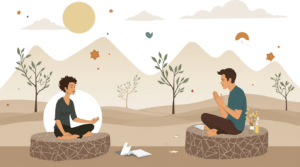
Belief is easy in theory.
It is easy to speak about values.
Easy to admire compassion.
Easy to discuss integrity.
Easy to say we believe in something greater.
The real test begins in ordinary moments.
Belief becomes meaningful only when it shapes behavior.
Spiritual insight becomes powerful only when it influences choice.
Religion may provide structure.
Spirituality may cultivate awareness.
But daily life reveals whether those foundations are alive.
Living your beliefs is not dramatic.
It is consistent.
The Gap Between Belief and Behavior
Many people hold strong convictions.
Yet there is often a gap between what is professed and what is practiced.
A person may value patience, yet react with anger.
Value honesty, yet distort truth when pressured.
Value compassion, yet ignore those who inconvenience them.
This gap is not uncommon.
It reflects the challenge of translating ideals into action.
Closing that gap requires intentional alignment.
Faith as Daily Discipline
Faith — whether religious or spiritual — is not sustained by occasional reflection alone.
It grows through repetition.
Daily habits reinforce internal orientation:
-
Setting aside time for reflection.
-
Practicing gratitude.
-
Exercising restraint.
-
Offering forgiveness.
-
Acting generously.
Small actions reinforce belief more than abstract declarations.
Consistency strengthens conviction.
Character as Evidence of Belief
Belief that does not influence character remains incomplete.
If a person claims to value dignity, their speech should reflect respect.
If a person claims to value truth, their actions should reflect honesty.
If a person claims spiritual awareness, their behavior should reflect patience and humility.
Character becomes the visible expression of invisible conviction.
It reveals whether belief is integrated or superficial.
Applying Values in Difficult Moments
It is easy to apply values when conditions are favorable.
The true test emerges in discomfort:
-
When criticized unfairly.
-
When tempted by convenience.
-
When anger feels justified.
-
When compromise appears easier.
Living your beliefs requires restraint when impulse urges reaction.
It requires courage when silence would be easier.
It requires humility when pride demands defense.
These moments shape integrity.
Relationships as Application Ground
Beliefs are tested most clearly in relationships.
Faith in compassion is revealed in how one treats family.
Spiritual awareness is revealed in how one handles conflict.
Religious conviction is revealed in how one speaks about those who disagree.
Living belief means embodying principle consistently — not selectively.
Responsibility and Influence
Living your beliefs extends beyond personal benefit.
It influences others.
Children observe behavior more than language.
Friends notice consistency.
Communities respond to integrity.
Beliefs lived consistently create trust.
Beliefs spoken without embodiment create skepticism.
Integrity builds credibility over time.
Humility and Ongoing Growth
Applying belief does not imply perfection.
Everyone falls short of their ideals at times.
The difference lies in response.
Do we acknowledge inconsistency?
Do we correct course?
Do we remain open to growth?
Humility sustains long-term alignment.
Without humility, belief hardens into pride.
With humility, belief refines character.
Integrating Inner and Outer Life
Spiritual awareness often begins inwardly.
But if it remains internal, it becomes isolated.
Integration means allowing inner clarity to guide outward action.
Reflection influences speech.
Conviction influences decision.
Gratitude influences attitude.
When inner life and outer behavior align, stability grows.
Life feels less fragmented.
Living With Intention
To live your beliefs is to act deliberately rather than react impulsively.
It means asking:
Does this decision reflect what I claim to value?
Does this response align with my convictions?
Does this action strengthen my integrity?
These questions transform routine into responsibility.
They shift life from accidental to intentional.
Beliefs — religious or spiritual — are not meant to remain abstract.
They are meant to shape the way we:
Speak.
Choose.
Forgive.
Disagree.
Commit.
Endure.
Living your beliefs is not about display.
It is about consistency.
When belief, awareness, and action align, life gains coherence.
And coherence, over time, becomes strength.