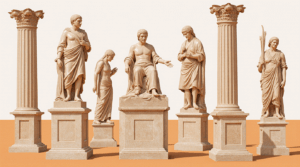
Human existence, knowledge, reality, and meaning have been perennial concerns that span not just millennia but also the vast expanse of human history, from ancient civilizations to the modern era. These concepts form a complex web of inquiries that philosophers throughout time have grappled with—each adding their unique perspective while acknowledging the interconnectedness of these fundamental questions.
In examining the history of philosophy, one cannot help but be struck by how deeply intertwined these existential and epistemological queries are. The search for meaning often leads to reflections on knowledge, which in turn raises questions about reality. Philosophers have pondered what it means to exist, how we can know anything, and why things appear as they do. These inquiries, while distinct, frequently overlap, creating a rich tapestry of ideas that continue to resonate with contemporary thinkers.
From the earliest recorded philosophical musings, philosophers have sought to make sense of their world. The ancient Greek philosophers like Thales, Anaximander, and Pythagoras posited theories about the nature of reality and existence. Thales suggested water as the fundamental substance, laying down a rudimentary form of materialism that has evolved over millennia (Kirk et al., 1983). This idea was revolutionary in its time, proposing a single element from which everything could be derived. Anaximander expanded this by introducing the concept of apeiron, the boundless or infinite, suggesting that the world was not static but perpetually changing. Pythagoras, on the other hand, introduced mathematical concepts to understanding reality, proposing that numbers were the essence of all things (Burton, 2005). These early thinkers laid foundational stones upon which later philosophers would build.
As time progressed, the scope and depth of philosophical inquiry expanded, reflecting broader societal changes and intellectual advancements. The Sophists in Greece raised critical questions about truth and knowledge, challenging traditional narratives and emphasizing the subjective nature of perception (Burke, 2016). Their emphasis on rhetoric and argumentation foreshadowed modern concerns with epistemology and skepticism. For example, Gorgias’ famous “On Nature” questioned whether anything can be known or truly exist, pointing to the limitations of human knowledge.
The Platonic dialogues represent a significant leap in philosophical methodology, introducing dialectic as a means to explore complex ideas through conversation. Plato’s theory of forms posited that there is a realm of perfect, unchanging essences that exist independently of the physical world (Plato, 1997). This idea has profound implications for understanding reality and knowledge, suggesting a dualistic view where the physical world is merely an imperfect reflection of these eternal truths. Aristotle, in contrast, emphasized empirical observation and logical reasoning to understand nature and ethics. His focus on the tangible world and its laws laid the groundwork for scientific inquiry that would later flourish during the Renaissance and Enlightenment periods (Aristotle, 1984). This shift towards a more empirical approach influenced later thinkers who sought to understand reality through direct experience and observation.
During the Middle Ages, philosophy continued to evolve within a theological framework. Thomas Aquinas synthesized Aristotelian thought with Christian doctrine, arguing for the compatibility of faith and reason (Lombardo, 2013). His emphasis on natural law reflected an attempt to reconcile rational inquiry with divine revelation, setting the stage for future discussions about ethics and metaphysics that would be explored by later thinkers like René Descartes. Aquinas’ work on natural law had a lasting impact, influencing legal and ethical systems throughout history.
Descartes famously declared “I think, therefore I am,” initiating a methodological approach to philosophy that prioritized doubt and systematic skepticism (Descartes, 1985). In his *Meditations on First Philosophy*, he sought to establish certain knowledge by doubting everything that could possibly be doubted, ultimately arriving at the indubitable truth of his own existence. This methodological skepticism had a profound impact on Western philosophy and laid the groundwork for modern rationalism. Descartes’ ideas resonated with many thinkers who followed, including Baruch Spinoza and Gottfried Wilhelm Leibniz, each contributing to the ongoing debate about the nature of reality and knowledge.
With the advent of the scientific revolution in the 17th century, Descartes’ approach began to dominate philosophical discourse. The work of Isaac Newton further solidified this shift by providing a mathematical framework that could explain natural phenomena with unparalleled precision (Newton, 1687). Newton’s laws of motion and universal gravitation not only revolutionized physics but also influenced how philosophers viewed the universe as a machine governed by strict, calculable rules. This mechanistic view of nature was further explored by later thinkers such as John Locke and Baruch Spinoza, each contributing to discussions about causality and determinism.
In the 18th century, Enlightenment thinkers such as John Locke, George Berkeley, and David Hume further deepened our understanding of knowledge. Locke argued that all ideas are derived from sensory experience (Locke, 1690), while Berkeley contended that only minds exist and material objects are nothing more than collections of perceptions (Berkeley, 1710). Hume’s empiricism led him to doubt the existence of causality as anything but a habit of thought (Hume, 1739). These debates reflected broader discussions about the nature of reality and knowledge, highlighting the tension between rationalism and empiricism.
The 19th and early 20th centuries saw the emergence of various new philosophical schools. Phenomenology, pioneered by Edmund Husserl, sought to reveal the structures of consciousness and experience (Husserl, 1931). By focusing on the subjective experience of phenomena, phenomenologists like Husserl aimed to understand the “essence” behind everyday experiences without relying on external explanations. This approach had a significant impact on later existentialist philosophers such as Jean-Paul Sartre and Martin Heidegger.
Existentialism, led by Jean-Paul Sartre, focused on individual freedom and responsibility, famously stating “existence precedes essence” (Sartre, 1946). This idea challenged traditional notions of human nature and the role of society in shaping individual identity. Sartre’s philosophy emphasized the primacy of choice and the burden of free will, reflecting a profound concern with authenticity and self-determination.
Analytic philosophy, championed by philosophers like Bertrand Russell and G.E. Moore, emphasized clarity through logical analysis of language and concepts (Russell, 1918; Moore, 1903). This approach sought to clarify the meanings of philosophical terms and concepts, often using formal logic to dissect arguments and identify fallacies. Analytic philosophy has had a significant influence on contemporary debates in ethics, metaphysics, and epistemology.
Post-World War II saw a proliferation of new theoretical currents in Western philosophy. Postmodernism, as represented by thinkers such as Michel Foucault and Jacques Derrida, challenged traditional narratives and questioned the stability of meaning (Foucault, 1972; Derrida, 1967). These philosophers emphasized the role of power dynamics and discourse in shaping our understanding of reality. For example, Foucault’s work on bio-power and governmentality explored how power structures influence individual behavior and societal norms.
In recent decades, globalization and technological advancements have created new philosophical challenges. The rise of digital technologies has sparked debates about privacy, autonomy, and the ethical use of data (Brennan et al., 2013). As personal information becomes increasingly accessible through online platforms and social media, questions about consent and surveillance have become pressing concerns for philosophers and ethicists alike.
Environmental crises have forced philosophers to reconsider traditional notions of progress and sustainability. Environmental philosophy, exemplified by thinkers such as Aldo Leopold and Timothy Morton, challenges the anthropocentric view of nature and advocates for a more holistic approach to environmental stewardship (Leopold, 1949; Morton, 2013). These debates reflect broader discussions about the ethical obligations we have towards non-human entities and the natural world.
These developments reflect a continuous dialogue between past and present, where each generation builds upon the foundations laid by its predecessors. The evolution of philosophical thought continues to shape our understanding of human existence, knowledge, reality, and meaning in complex and dynamic ways. As we navigate an increasingly interconnected world, these philosophical inquiries remain as relevant as ever, offering valuable perspectives on our individual and collective experiences.
The journey from Thales’ materialist musings to contemporary debates on digital ethics and environmental responsibility is a testament to the enduring power of philosophy as a tool for critical inquiry and self-examination. As we face new challenges in an ever-changing world, philosophical reflection continues to provide us with the tools to navigate these complexities and find meaning amidst uncertainty.